
A grain drill’s seeding chart is a useful place to start, but it doesn’t always tell the whole story. Wear, tire changes and replaced parts can affect how much seed a drill actually delivers. Calibration helps close the gap between the rate a farmer intends to plant and the rate coming out of the drill.
The Grain Drill Calibration Calculator, now available from CU-CAT Apps, puts a familiar Extension procedure into a format farmers can take to the field.
The cost of a missed target can add up. Consider a hypothetical 100-acre planting with a target rate of 20 pounds per acre and seed costing $3 per pound. If the drill delivers 10 percent more than intended across the field, it would use an extra 200 pounds of seed—$600 in additional seed cost. The actual difference depends on the drill, seed, conditions and acreage; calibration helps reveal whether an adjustment is needed.
Planting too little can carry costs, too. Low seeding rates can lead to thin stands susceptible to weed encroachment, while excessive rates increase seed costs.
The idea for the calculator began with a conversation between Clemson Extension’s Matt Burns and his father, Gary Burns, who was formerly the Beef Farm Manager at Clemson's Simpson Station in Pendleton, SC. After using the University of Kentucky’s AGR-254 procedure to calibrate his drill, Gary asked why the process couldn’t be built into an app around the Extension guide.
Matt passed the content to Amos, the Clemson Extension Mesonet AI assistant created by Alex Mann, which produced the first version. The source code then went to the Clemson University Center for Agricultural Technology (CU-CAT), where the team adapted it to the CU-CAT Apps template and added content from other sources. The calculator joins a collection of on-farm decision aids developed and hosted by CU-CAT.
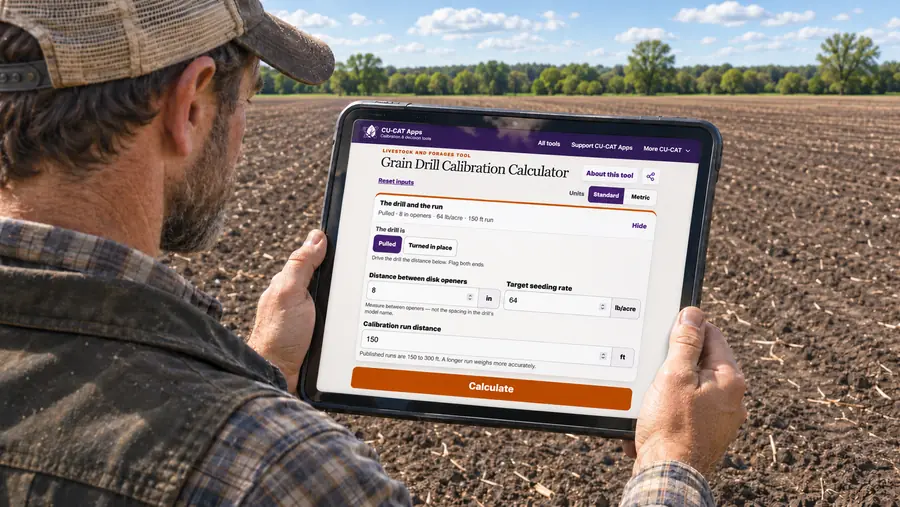
The tool supports the catch-and-weigh method described in AGR-254, Grain Drill Calibration: Don’t Make a Mistake—Calibrate. Given the opener spacing, target seeding rate and length of a calibration run, it calculates how much seed each opener should deliver and a range within 10 percent of that target. Farmers can also enter the seed collected during the test to see the estimated actual seeding rate and how it compares with the goal.
The calculator makes the arithmetic easier while keeping the hands-on check at the center of the process. Seed lots can differ in size, shape and coating, so a setting that worked for one lot may need adjustment for another. Taking time to calibrate helps farmers make a more informed start before heading across the field.