
A small engine that won’t start can bring a much bigger job to a halt. When a water pump, portable generator, pressure washer or sprayer won’t run, the work that depends on it may have to wait.
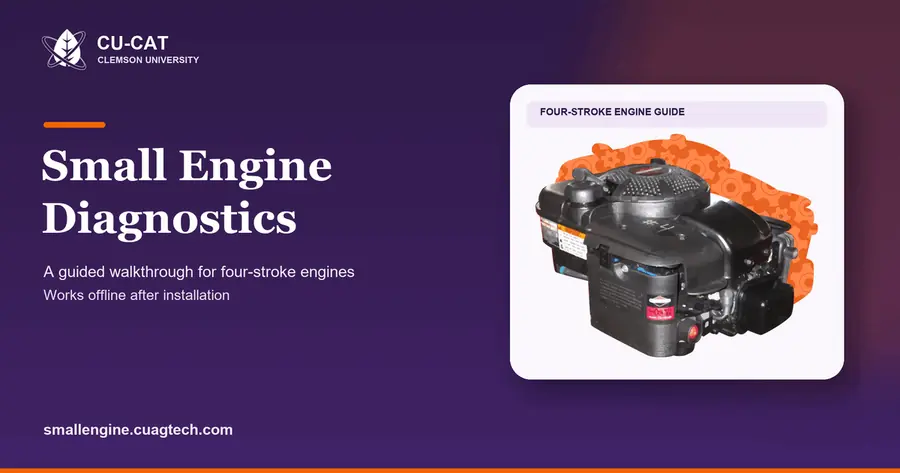
A Clemson-developed resource designed to help people work through those problems is available again. The Clemson University Center for Agricultural Technology (CU-CAT) has re-released Small Engine Diagnostics, a free, guided reference for troubleshooting common problems in non-running, four-stroke, spark-ignition small engines.
The tool has its roots in a Clemson teaching exercise and in the practical experience of a local mechanic who loves to teach. Its return gives South Carolina farmers and agribusinesses another resource they can carry into the shop or take with them in the field.
From the repair shop to the classroom
The diagnostic approach behind the tool began with Joe Whitlow of Anderson Outdoor Power Equipment. Kendall Kirk, now with CU-CAT, worked under Whitlow as a mechanic for roughly two years and learned from both his knowledge of small engines and his willingness to teach others.
Whitlow’s approach was methodical: work through the possibilities, starting with common causes and checks, and let each observation guide what comes next. That process became the foundation for a laboratory activity in Clemson’s Agricultural Mechanization and Business program and, later, the original Small Engine Diagnostics and Repair app.
The project brought together Clemson faculty, staff and students with developer Cory Buckley, who built the web interface and maintained the mobile app. Hillary Valdetero collected photographs and organized visual resources for the guide. She also helped evaluate its effectiveness as a teaching resource.
In a Clemson classroom study, students using the app or a printed version of its diagnostic process were more successful at identifying an assigned engine problem than students using an engine manual and troubleshooting guide. The findings pointed to the value of the diagnostic process itself, whether delivered on a device or on paper.
After a period when the tool was no longer available, CU-CAT set out to bring it back. People who remembered the original had asked for its return, and the practical knowledge at its core remained worth sharing.
Built for the places work happens
The new edition retains much of the original guide, including its diagnostic paths and reference photographs, while updating it for current devices and accessibility. With assistance from artificial intelligence, CU-CAT was able to bring the tool back to life and make it available again.
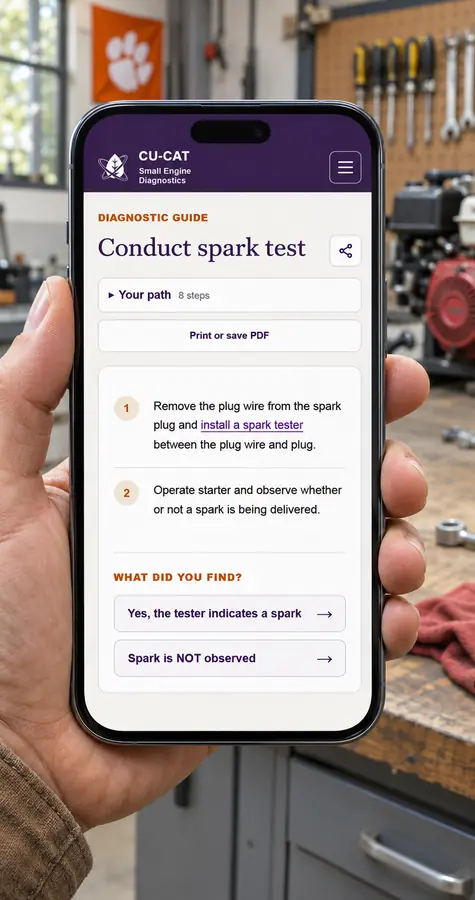
The guide follows a user’s observations through a series of diagnostic choices, with linked photographs to help identify parts and tools. It also saves the user’s place on the device, making it easier to return to a diagnosis after stepping away.
One feature is especially relevant on farms: the guide can work offline. Once it has been opened while connected and offline access is ready, the guide and its images can be used without an internet connection. That means a user can take the reference into a shop, across the farm or to another location where connectivity is limited.
The tool is designed for four-stroke, spark-ignition small engines. It is not intended for two-stroke engines, and it cannot account for every engine or every possible failure. It is an instructional reference to be used with the engine manufacturer’s service information and the guidance of a qualified small engine repair professional.
Practical knowledge, made available again
For a farmer or agribusiness, having a structured place to begin can make an unfamiliar engine problem less daunting. The guide encourages users to observe the engine and consider common causes in an organized way. That can help people learn more about their equipment and make better-informed decisions about what to check or when to seek repair assistance.
Its usefulness extends beyond agriculture, too. Teachers, students, homeowners and others who work with small engines may find value in the same practical approach. But bringing the guide back also fits CU-CAT’s central mission: putting useful technology and knowledge to work for South Carolina’s farmers and agribusinesses.
Small Engine Diagnostics is available free at smallengine.cuagtech.com. Open it while connected and allow offline access to finish preparing before taking it somewhere without a connection.